War of the Words: Media Literacy in the age of Misinformation
Introduction
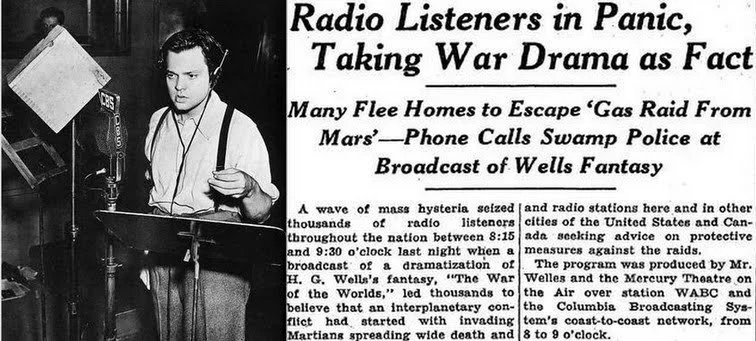
In 1938, a young Orson Welles adapted and performed his legendary radio broadcast of the War of the Worlds. The story about alien invaders attacking Earth was so convincing, many listeners of that infamous CBS broadcast believed it was actually happening. Mass hysteria ensued with varying reports of abandoned homes, traffic jams on the freeways, and citizens arming themselves in preparation for the Martian hordes. When the dust settled the next day, Welles assured the newspapers that it was never his intention to create such a dangerous reaction in the public. However, over the years he said in multiple interviews he had always hoped to fool some of their listeners, in order to teach them a lesson about not believing whatever they heard over the radio.
What Orson Welles knew almost 90 years ago was the simple fact that audiences want to believe what you present to them. We call it the suspension of disbelief, it’s the crucial essence of entertainment that allows the audience to ignore their knowledge that what they’re experiencing is not real. While the ability to disengage with reality is what makes any form of entertainment enjoyable, what happens when the viewer doesn’t realize that what they’re experiencing isn’t meant to be entertainment? What happens when media creators intentionally mislead or outright lie to their audience about the legitimacy of their work? What would’ve happened if the Twitter and computer generated images existed when Welles told the nation that we were under attack?
This is why media literacy is so important, because it gives us the ability to use critical thinking to ascertain the authenticity of mass media. As the world hurdles into a new digital landscape of deep fakes and artificial intelligence, media literacy may be the last line of defense for an increasingly fragile society. Studies have shown that media literacy education can help people better discern the truth of media claims, enabling them to detect "fake news" and make more informed decisions. From newspapers to radio and television to internet, media has always been influential on culture and society. However, media literacy is not something that is highly valued or taught in American society.
Television news broadcasts, serial dramas, sitcoms, and talk shows all contributed to the changing norms, fashions, and language of American culture over the generations. By the end of television’s first decade, it was widely believed to have greater influence on American culture than parents, schools, churches, and government institutions that had been until then the dominant influences on popular conduct. Television and movies were so important to American culture that they remained the dominant form of entertainment and information for the next sixty years, right up until the end of the century.
As the new millennium approached, an invention called the internet began to take shape. When the concept of social media was introduced in the mid 2000s, nobody understood the Pandora’s box that had just been opened. Social media has increasingly grown in power and influence and has acted as a medium to accelerate sociopolitical movements. The internet became an integral part of daily life as it could be used for not only entertainment and information, but also communications, business, and even turning strangers into friends. People suddenly didn’t need to rely on privately owned broadcasting corporations for their information, they could get it straight from one another. Amateur journalists, internet influencers, and pseudo scientists were suddenly becoming more important and profitable than traditional mass media. And this change in the dynamic of power has caused enough harm, that the future of humanity is looking rather bleak.
Fake News, Politics, and Confirmation Bias
The world watched in horror on September 11th, 2001 as images of the destroyed Twin Towers were broadcasted on all major news networks around the globe. When America invaded Iraq and the war on terror ramped up, the numbers of dedicated viewers of broadcast news skyrocketed. Decades before this event, the assassination of president John F. Kennedy would be the first time that all major news broadcasters were live on the air, 24/7 around the clock. That was a turning point for TV news, which overtook newspapers as the primary source of information for the country.
Throughout most of the modern era, society’s relationship with historical events has been directly influenced by how we experienced that event through mass media. The Vietnam war, the Berlin wall, and the Great Recession, were all real world events that were contextualized through the lens of television news broadcasts. More modern events such as the Covid-19 pandemic, the war in Ukraine, and the Black Lives Matter movement were experienced through social media and mobile devices. The way our human mind interprets and catalogs these events in our memories, is influenced by the bias of the media by which we are experiencing it. This is why the concept of objective journalism, or unbiased journalism has always been an important goal for traditional outlets of mass media. However, journalism is also a business driven by audience engagement and subscriptions. The struggle for a real newspaper doing real investigative journalism to make money, has gotten significantly harder in the past couple decades with the rise of alternative new sources online.
This has caused most, if not all of the most heavily trafficked platforms on the internet to paint varyingly one sided pictures of historical events. The media are turning into crowd sourced Ministries of post-truth not because of some underlying conspiracies but due to their business needs and the settings of a broader media environment. As a result, the objective reality of every historical event has become influenced and biased towards particular ideological markets. This is partially the cause behind some of the more damaging conspiracies in society of late, such as 2020 Election Denial and the subsequent January 6th insurrection. These markets are analyzed and categorized by platforms such as Youtube and Facebook through Artificial Intelligence programs. As I am sure we all know, whenever we use a social media platform on our phone or computer, that platform is monitoring how we use it. These programs create recommendation algorithms based on our viewing behaviors, and show us personalized feeds of content designed to keep us online longer.
In the online media economy, the artificial intelligence in algorithms are single-minded in achieving their profit-driven agendas by ensuring the maximum frequency of human interaction by getting the user to click on an advertisement. The creation of these different political markets is highly influenced by Confirmation Bias. According to the American Psychological Association, Confirmation Bias is defined as the tendency to gather evidence that confirms preexisting expectations, typically by emphasizing or pursuing supporting evidence while dismissing or failing to seek contradictory evidence. This drive to seek like minded opinions and groups has created communities of informational echo chambers online. Objective sources of news and information cannot penetrate these communities as the members do not allow any alternative viewpoints in their midst. What follows then is an ill-informed faction of society protected from criticism within their echo chamber of misinformation.
Of course, when the entire world’s discourse about real time political issues are happening on an unregulated platform of biased sources, rumors are bound to spread. However, the increase in claims of ‘fake news’ and ‘cancel culture’ by political figures doesn’t hold up to the scrutiny of media literacy. To clarify, 'Rumors' are unverified information or statements circulated with uncertainty, and 'fake news' is the misinformation that is distributed in an official news format. When someone claims that ‘fake news’ is to blame for the scandal of the day, what they are saying is that a deliberate choice is being made by a licensed news outlet, to spread a false claim. If this were true then major lawsuits and risk of (legitimate) broadcasting licenses revocation would be rampant. What is being credited as ‘fake news’ is really biased news attempting to satisfy their customer market.
So what exactly can media literacy do to help in identifying political misinformation and breaking up social media echo chambers? Media Scholar W. James Potter observed that all media messages include four dimensions; Cognitive, Emotional, Aesthetic, and Moral. When we experience an advertisement or read a news source we should ask ourselves the following questions; What did the creator what us to believe (cognitive) about the message? How did the creator want us to feel (emotional) about the message? How did the creator present (aesthetic) the message? And is the creator acting in good (moral) faith?
These questions are designed to analyze and understand the motivation behind the media we are consuming. When we can understand the purpose behind the message, we can start to understand the creator’s end goal. Is this news source trying to get me to support a certain candidate? Is this video trying to promote a particular ideology? Is there a conflict of interest based on who is advertising on this platform? The effects of echo chambers can be hard for members to break, especially when they are tied to the group through politics and identity. Unfortunately, the tribalism of social media doesn’t just happen in politics, it has made a massive impact on the entertainment industry as well.
Entertainment, Woke-ism, and Conformity
Without a doubt, one of the greatest influences on society and culture has been the Hollywood entertainment industry. However, the influence of negative racial representation and lack of cultural diversity in cinema has been an issue of debate in recent decades. Despite its role as a cultural arbiter of societal norms, the entertainment industry has always been a secretive community with a legacy of scandals since its very inception. Traditionally, the major film studios such as MGM and Paramount have ruled the Hollywood system with absolute authority and control. In the golden age of the 20s for instance, actors were not allowed to work without major studio endorsement and no productions were financed outside of the studio system.
These studios discovered, promoted, and contracted movie stars as products to generate revenue, removing all humanity from the individual and the system. Studio publicists built wholesome off-screen images of stars that no actor could live up to and covered up scandals when actors went too far. Historically, the only criticisms of the Hollywood system came from nationally recognized film critics, which were usually sanctioned by licensed news outlets. This created an environment removed from the rest of society, yet was still the greatest influence on its culture.
However, the rise of new media platforms on the internet has now allowed everyone to become an entertainment critic, and these unsanctioned voices have made themselves heard. On Jan. 15, 2015, media strategist April Reign would make history with a simple tweet that had major repercussions for the Hollywood industry. That year, the academy of Motion Pictures awarded all 20 acting nominations to white actors for the first of two consecutive years, inspiring April Reign to create the hashtag #OscarsSoWhite. This quickly started a conversation and reflection online regarding the under representation of people of color in the entertainment landscape. Not only this, but a retrospective of misrepresentation of minorities and its impact on popular yet negative stereotypes in society, put the Hollywood industry on the defense. This painful and insightful look at our shared culture began to shed some light on the very real consequences in our society. In the hopes of counteracting this, major motion picture studios suddenly began promoting more minority lead productions and castings.
Additionally, 2017 would turn out to be an incredibly important year in the fight for women’s equality with the #MeToo movement. That year, Hollywood kingpin Harvey Weinstein was accused by actors Ashley Judd and Rose McGowan of sexual harassment and assault in the New York Times. As the story spread across social media, other women felt empowered to tell their own stories of sexual abuse in Hollywood with the hashtag #MeToo. The movement spilled over to Facebook too, where about 4.7 million users shared 12 million posts in fewer than 24 hours. Despite his status as an untouchable giant amongst the Hollywood elite, the negative press started by an online movement would lead to the eventual downfall, conviction, and imprisonment of Harvey Weinstein. Other famous and powerful men would soon follow and meet justice as well because of these women’s stories online. Clearly, these tales of assault were not only happening within the Hollywood system but also in the world at large.
As society came to grips with these revelations of rampant sexual assaults, we began to re-evaluate our depictions of women in popular culture. More positive depictions of women in film and television became part of the shifting cultural ideas regarding entertainment’s role in society. Much like people of color, more women were being promoted as powerful heroines, in an attempt to redefine gender stereotypes. The goal of this not only to inspire younger generations of minority children, but to also change the way we view racial and gender minority stereotypes. However, as Hollywood began to create a more inclusive world for everyone, many young boys began to feel victimized.
In the modern media landscape, YouTube and Tiktok are the biggest challengers to legacy media giant of Hollywood. When it comes to the younger audience market in particular, the Social Media Influencer is arguably more revered and recognizable than modern movie stars. These celebrities of the new media age often align themselves with different ideologies or political groups (much like news outlets), to maximize their audience engagement. Many of these influencers’ audiences find their content through the previously mentioned recommendation algorithms used by all major social media platforms.
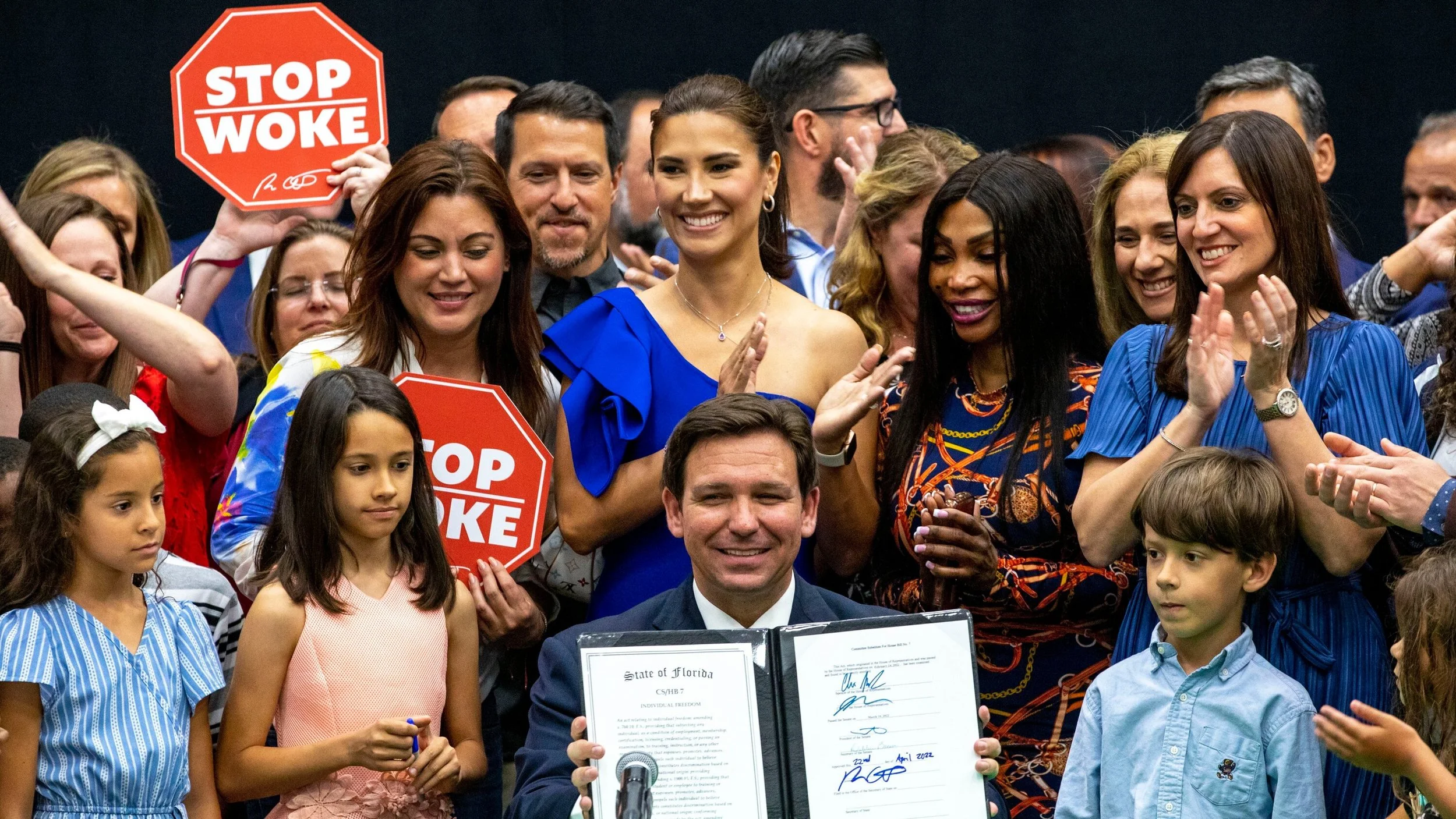
As many young, white males found themselves feeling rejected and scorned by their beloved Hollywood movies, a power vacuum of culture was filled by these online influencers. The backlash by certain echo chambers of toxic masculinity would soon claim that Hollywood was going woke, a descriptor that has gained massive traction in the past few years. According to many social media influencers, an onslaught of woke movies and television shows are attempting to foundationally change the culture of America to include “less white, heterosexual men.” This trend of claiming that any kind of social inclusion of minority communities is akin to woke-ness, has recently left the realm of entertainment and moved on to become the hottest buzzword in all areas of life.
However, when looking at the data it doesn’t seem that Hollywood has gotten any less white over the years outside of one particular market. In the last 16 years, the percentage of Asian characters with speaking roles onscreen skyrocketed from 3.4% to 15.9%. In that same time period, Black characters saw little change, from 13.0% to 13.4%, and the proportion of Latino characters grew from just 3.3% to just 5.2%. Many say these changes of racial representation in entertainment is a deliberate attempt to erase white cultural heritage. However, white people represented 78% of the lead actors in the top movies released in theaters in 2022, up from 72.4% in 2019, according to the newest UCLA Hollywood Diversity Report. Yet despite the lack of evidence that any of this is even happening, many are convinced that woke-ness is a real problem in our culture, why?
Part of the reason for groups of these like minded reactionaries’ existence is the need for its members to feel accepted through their conformity. Conformity is the adjustment of one’s opinions, judgments, or actions so that they become more consistent with (a) the opinions, judgments, or actions of other people or (b) the normative standards of a social group or situation. Since most of these groups exist because of a certain belief such as “Hollywood is too woke,” in order for new members to be accepted they must also conform to that belief. As many of these isolated and scorned young men find each other online, the number of anti-woke movements grow. Even in the face of contrary evidence, conformity to the ideals and beliefs of the group is the more important than being factually accurate. The feelings of acceptance, comradery, and unity are addicting emotional states for a social species like ours.
The real problem here once again, is the lack of media literacy in the audiences regarding art like film and television. The message of the films and intentions of the film makers become distorted in the online war for audience engagement. The rules we’ve established previously regarding how to use media literacy should be used on both the art and the critics. We need to ask ourselves which is more likely; that there is a vast conspiracy to erase white history through Hollywood films, or that social media influencers gain major audience engagement by saying the newest superhero movie is indoctrinating children? When we consider the four main aspects of media literacy (Cognitive, Emotional, Aesthetic, and Moral) during our analysis of entertainment, it can help break the echo chambers of many younger audiences online.
Despite the rage from certain groups online, these dissidents of cultural evolution have been largely ignored by mainstream media until recently. Social media influencers and other major industries have identified these new ideological markets, and have decided to chase the profits they see there. Many of us believed that given enough time these fringe groups would have just disappeared. Unfortunately, the opposite has happened, and these groups have not only persisted but have actually thrived in the online world. But conspiracy theories are nothing new, and there have always been groups of individuals who are unable to accept simple reality. But the social media has given rise to a new standard of outlandish ideas never before thought believable.
Social Media, Conspiracies, and Groupthink
Somewhere around the year 1610, Italian astronomer Galileo Galilei created the most powerful telescope in the world up until that time. With his new invention, he was able to uncover vast secrets about the true nature of the universe and helped to kick start the Scientific Revolution in Europe. However, when his scientific discoveries began to question the commonly believed realities of his day, he learned that truth is in the eye of the beholder. When Galileo sided with Copernicus, whose work was put on the Catholic Church's Index of Forbidden Books in 1616, he opened himself to the possibility of formal censure for heresy. And that’s exactly what happened in 1633 when Galileo was found guilty of heresy against the church and sentenced to live out the remainder of his life under house arrest. Even though history would prove many of Galileo’s ideas to be correct, objective reality is not always accepted by society.
The complex and existential nature of the universe is a concept that has plagued mankind’s imagination throughout history. The fact that the universe is completely chaotic and random, is too terrifying for many humans to accept. The desire for the world to make sense is why our brains instinctively see patterns, often when no pattern exists. But sometimes even when an explanation is provided to us, we may still reject that answer based on various personal biases. Additionally, humans are curious by nature, and it satisfies our curiosity when we don’t have enough data about something. To the human brain, a false explanation is better than no explanation. Believing that climate change is a hoax relieves the fear of global extinction, believing that Covid-19 was a planned event removes the random nature of a deadly pandemic.
Most often times, the fear of unpredictable events becomes the motivation for many to seek out an already established belief system for guidance. While for many this can lead one to focus on religion, work, or hobbies, but for many others it can lead down a rabbit hole of conspiracy theories. Since a number of studies have shown that belief in conspiracy theories is associated with feelings of powerlessness, uncertainty and a general lack of agency and control, a likely purpose of this bias is to help people “make sense of the world” by providing simple explanations for complex societal events restoring a sense of control and predictability. Conspiracy theories are nothing new to human history, the ability for individuals to reject accepted reality has been an issue for society since the start. The good news is that this seemingly disconnection from the real world affects a relatively small population. However, those that subscribe to the world of conspiracies are likely suffering from severe delusions, which may also lead to incidents of real world violence.
A delusion is defined as an often highly personal idea or belief system, not endorsed by one’s culture or subculture, that is maintained with conviction in spite of irrationality or evidence to the contrary. On a macro level, there is nothing inherently wrong with an individual not subscribing to the majority beliefs of the rest of society (excluding the legality of those beliefs). Part of the freedoms associated with living in an open culture, is the freedom for an individual to dissent and form their own opinions. But more often than not, these delusions may lead to a disruption of relationships, changes in daily behavior, and possibly even violence.
There are countless societal fears in the modern era including mass shootings, political unrest, and economic inequality. Despite the reality that each of these issues can be explained through historical, illegal, or political factors, many will still turn to conspiracies and pseudo-science to explain the complexities of modern life. However, unlike the conspiracies of the past such as the faked moon landing, modern conspiracies need to reflect an ever increasingly technological world. Modern conspiracies being perpetuated by the social media echo-chambers need to devolve into more and more absurd claims, to stand out in an overly crowded customer market. To do a quick search online, one can learn that the Earth is actually flat, Jewish space lasers cause global warming, and every election is rigged. All of these conspiracies, were created by those unable to cope with an objective reality that doesn’t align with their desires or perceptions.
One of the psychological concepts that can help understand how these individuals can hold such outlandish worldviews is Groupthink. According to the APA, Groupthink Symptoms include apparent unanimity, illusions of invulnerability and moral correctness, biased perceptions of the out group, interpersonal pressure, self-censorship, and non-optimal decision-making strategies. Causes are thought to include group cohesion and isolation, poor leadership, and the stress involved in making decisions. With this knowledge, we can begin to understand how these ridiculous claims can gain traction. Even if these claims are outlandish, the power of Groupthink keeps the believers from engaging with contrary, yet accurate information. However, as a single conspiracy takes off and gains in popularity, it’s members will soon move onto a newer conspiracy, one with seemingly less publicity. While on the surface, it can seem like these conspiracies are happening organically by way of paranoid individuals, the truth behind their origins is actually more sinister
When we use media literacy to break conspiracies down even further, we notice a trend when we ask ‘who is funding these online influencers to spread these radical ideas?’ The answer is think tank organizations funded by influential billionaires and special interest groups. Many of these organizations are responsible for quietly paying popular online mouth pieces to muddy the national discourse. Massimo Pigliucci, a philosopher at the City College of New York and author of Nonsense on Stilts: How to Tell Science from Bunk explains it best; “They're old-school propagandists with new-school, tech-savvy reach. They've been ginning up so-called research for everyone from shady corporations to anti-LGBTQ groups to white supremacists for decades---they're practiced, and their faux-academic veneer is thick and glossy.” These think tanks use their seemingly endless amounts of dark money in an attempt to shift cultural norms to reflect their own worldviews. These groups have made a significant investment in the online marketplace of ideas, because they know that the next generation is highly influenced by social media personalities.
These attempts have seemingly failed however, as it appears the newer generations have not taken the bait. And despite how it may seem to many of us, evidence would suggest that conspiracy theorists are no more prevalent today than they ever were. Across four studies––including four distinct operationalizations of conspiracism, temporal comparisons spanning between seven months and 55 years, and tens of thousands of observations from seven nations––we find only scant evidence that conspiracism, however operationalized, has increased. Still, the fact that followers of these kinds of claims even exist, speaks to the level of vulnerable individuals in our society. When these vulnerable and desperate individuals indulge in misinformation and conspiracies for comfort, they can quickly become radicalized and dangerous.
Equality, Cognitive Dissonance, and Dis-Information
The issue of racial and gender inequality has been a blemish on the legacy of the United States since its founding in 1776. The struggle for equality was fought and bled for throughout our history, including during the Civil War in the 1860s, the Civil Rights movement in the 1960s, and the Black Lives Matter movement in the 2010s. Despite the commonly accepted belief that racism and inequality are wrong, there are still many antisocial individuals who reject these societal norms. As we have discussed; the profit driven news media, the reflexive entertainment industry, and paranoid conspiracy theorists have all contributed to the perpetuation of a toxic online environment. While historically these messages have used traditional media to accelerate their message, social media has allowed these propagandists to spread their hatred at alarmingly fast speeds.
We’ve discussed the use of term woke as an attack by online critics, however the term has a very real origin. The use of the concept “woke” in American Black communities dates back to at least the 1930s but more recent usage in the community, especially online on Black Twitter, is as a warning to “stay alert to racially motivated police violence.” In 2013, the hashtag #BlackLivesMatter started appearing on social media after the acquittal of George Zimmerman in the shooting death of Trayvon Martin. This sent a message to the African American community in the United States that black lives, were not as precious as White lives in our society. Soon, more stories of other black men and women being killed by police officers gained attention online as well, thus launching the #BlackLivesMatter movement. Remembering what we’ve discussed about the journalism industry, it’s no surprise that the news media quickly began to cover these stories in an attempt to keep the ratings up.
However, this may have had some unintended consequences as the media turned each tragedy into fodder for the American public by repeatedly and casually showing them on television. That action has potentially further devalued their deaths and the deaths of the countless other Black men and women who have been murdered before and after them. The issue of racial inequality quickly became a raging debate online between #BlackLivesMatter supporters and those who aligned with counter-slogans such as #AllLivesMatter or #BlueLivesMatter. Many of these detractors of the BLM movement insist that the claims of state sponsored murders of black citizens, were not accurate. Most of these anti-BLM voices were refusing to accept the objective reality that the rest of society already knew, racial equality in America is still not equal.
As we’ve previously discussed with groupthink and conformity, Cognitive Dissonance is another possible explanation for this reaction. Cognitive Dissonance is an unpleasant psychological effect resulting from a belief between two or more inconsistent ideas. It is presumed to involve a state of heightened arousal and to have characteristics similar to physiological drives (e.g., hunger). Thus, cognitive dissonance creates a motivational drive in an individual to reduce the dissonance. Since many of those on the anti-BLM side of the argument are themselves white, they have not lived the African American experience in our society. It is difficult for these individuals to believe the tragic reality of modern American, and that disbelief forces them to use pseudo-philosophy and bogus studies to back up their feelings.
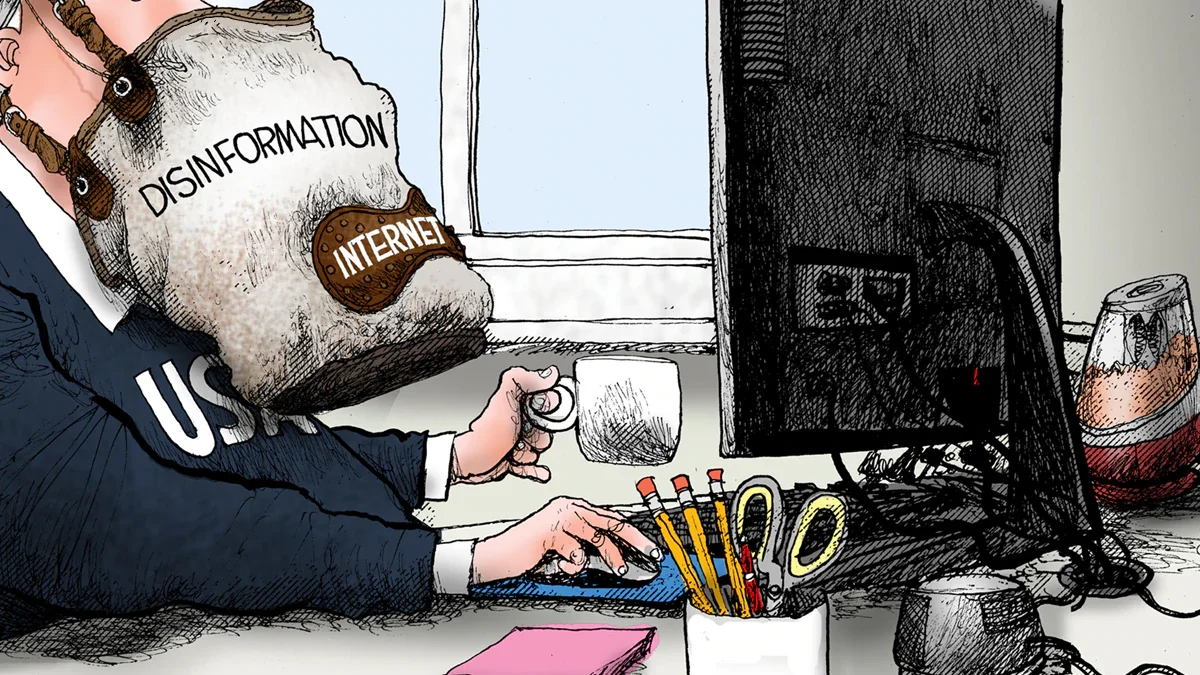
Many of these online skeptics have fallen victim to the newest tactic in the modern culture wars, which is the conflating of misinformation and disinformation. Misinformation is incorrect information that comes about through human errors. Misinformation is not meant to be inaccurate, however individuals are fallible and sometimes get the facts wrong. In the past, if a news outlet would report misinformation, this would be corrected through a retraction and correction during the next broadcast. However, disinformation is inaccurate information that is intentionally designed to mislead people. Employers of disinformation are purposefully trying to discredit a certain idea by tricking their audience into believing untrue statements. Yet another related term, mal-information, is accurate information that is used in different contexts to spread hatred or abuse of a person or a particular group.
This tactic of using true statements in a misleading way is bit tricky to understand, so in an attempt to contextualize it better let’s use a real world example such as #GamerGate. In 2012, an online personality named Anita Sarkeesian, created a video series entitled Tropes vs. Women in Video Games. This video series gathered a lot of attention from the mainstream media, with its examination of the misogynistic elements of video gaming characters and culture. This created a massive backlash from video game fans, mostly young males defending their favorite form of media. As the years went on, these angry mobs would begin to employ more destructive means of managing their dissonance. By manipulating statistics and misrepresenting statements by critics, these groups can change the way a bystander feels about the subject.
Hundreds of opinion videos flooded social media, all of them fiercely rebutting these claims of video game misogyny. This led to the creation of the #GamerGate hashtag on social media, calling out the increasingly violent and sexist rhetoric of the debate. In the fall of 2014, under the premise that they were angry at “unethical” games journalists — a lie that persists today — thousands of people in the games community began to systematically harass, heckle, threaten, and dox several outspoken feminist women in their midst, few of whom were journalists. Video gamers who happened to be female, were constantly harassed and discredited within the hobby community they loved. Threats of death and rape were a nonstop occurrence for female gamers on social media during the #GamerGate saga.
Whether it be racial inequality or gender inequality, social media has allowed these debates to happen like never before. As with every advancement in society, there will always be those that feel persecuted. Social media has provided people a barrage of content that is specifically cultivated to trigger an engagement with the viewer. Most often times, this engagement is strongest when it comes in the form of anger or fear. Using the frustration aggression hypothesis, we can theorize about why society seems more unhinged nowadays.
The frustration aggression hypothesis states; When people are frustrated, they experience a drive to be aggressive toward the object of their frustration, but this is often impossible or inappropriate, so the source of their aggression is displaced by something or someone else. Since so much of the online discussion involves the amending of cultural norms and politics, those in the debate generate immense frustration. Almost all of the time, two sides of an online fight will never meet or speak more than once. But there are a lot of trolls with phony names, anonymous hate accounts, and A.I. bots to keep that frustration going. As a result, social media users can eventually start to vent that frustration on others in their real life. Media literacy can help to counteract these feelings by teaching the users how to engage effectively with one another, and how to identify disinformation.
Conclusion
Mass media and culture have always been directly intertwined, one informs the other and vice versa. But media is also a tool that is used to spread one’s message and the honesty of that message is entirely based on whom is using the tool. Individuals looking to spread misinformation, confusion, or decent from societal norms, have traditionally be repelled by the legacy media outlets. With the creation of the internet and social media in particular, society is now far more susceptible to these fringe voices. The globe has recently shifted towards international and political uncertain, and there is no end to dishonest actors looking to take advantage of that uncertainty. The guardrails of cultural norms in society have been eroded with the rise of social media, and the decline of the major broadcasting outlets. It has now become the responsibility of the individual viewer to decrypt the real nature of what they are experiencing.
As we move forward into a new era of human interaction and communications, the challenge of identifying dishonest media looks more difficult than ever. The creation of Artificial Intelligence in particular, could be the genie let loose on the planet in irreversible ways. Despite this, it looks like social media will not be going away any time soon and that doesn’t have to be a bad thing. Even though social media has done massive damage to society, it has also made massive leaps forward in culture and representation. Media literacy education should be an essential part of everyone’s life as it helps everyone protect our society’s health and longevity.
